


Back to the beginning | go to Blog Articles
References and Documents
References
Papers
HIDROSTAN® Technical Data Sheets >
HIDROSTAN® Materials Kit
HIDROSTAN® Installation Manual
Brochure


Back to Blog Articles | Contact
Basic information
Waterproofing Foundations
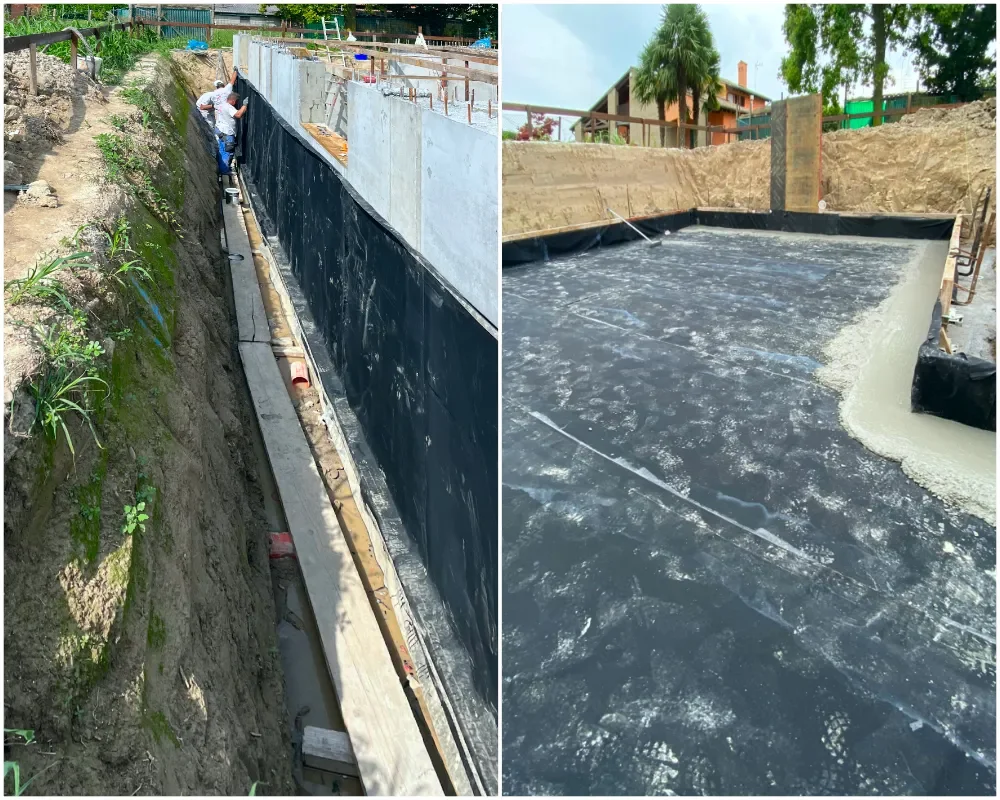
Correct installation of EPDM membrane Hidrostan membrane at the foundations is of fundamental importance in ensuring the durability and effectiveness of the waterproofing system against moisture and infiltration from the ground. Thebasic stratigraphy involves the creation of a lean concrete slab, i.e., an unreinforced concrete slab, directly on the ground to create a regular, stable, and dry surface. It is also essential that the surface is flat, free of sharp edges, debris, sharp gravel, or standing water, as any irregularities can compromise the integrity of the EPDM membrane.
The waterproofing installation involves laying the Hidrostan waterproofing membrane, which can be cut to size directly on site or supplied cut to size from the factory, following the planimetric development of the foundation, where the joints between the sheets are made by cold welding with specific adhesives supplied by the manufacturer, with a minimum overlap of at least 10 cm between the edges.The subsequent layers afterlaying the membrane involve the application of a non-wovenfabric(TNT) of suitable weight (minimum 300 g/m²), and the creation of a cement layer for the installation of iron reinforcements and subsequently concrete.
For further technical details or design support in defining stratigraphy and laying patterns, it is advisable to contact the company's technical department directly.
EPDM membranes as a barrier against gas coming from the subsoil
Although the primary function of EPDM waterproofing membranes, such as Hidrostan, is to ensure perfect waterproofing against moisture and water infiltration, they also perform exceptionally well in limiting the migration of certain gases from the subsoil, thus assuming a secondary but strategically important role in specific environmental contexts. It is possible for gases to rise from the subsoil into the built environment. These gases, in addition to posing a potential risk to the healthiness of indoor environments, can also compromise the durability of sensitive building materials.
Thanks to their compact and stable molecular structure, EPDM membranes offer:
Low gas permeability: diffusion through the membrane of molecules such as radon, methane, or other light gases is severely limited;
Excellent chemical resistance: the chemical inertia of EPDM makes it insensitive to attack by gaseous agents or contaminating vapors;
Long durability: stability over time guarantees consistent performance for decades, even in environments subject to thermal and chemical stress.
Although EPDM membranes are not designed exclusively as gas barriers, they can be effectively integrated into a multi-layer environmental protection system, proving particularly advantageous for controlling gas migration, especially when combined with ventilation layers, drainage geocomposites, or specific barriers certified for gas containment.
DESIGNING WATERPROOFING FOR FOUNDATIONS
In contemporary construction, the design of a waterproofing system for foundations is of strategic importance, especially in terms of durability, sustainability, and ease of installation. The technology of Hidrostan EPDM membranesstands out for its extraordinary ability to adapt to the actual conditions of the construction site and the actual dimensions of the surfaces to be waterproofed.
The design of a waterproofing system must take into account multiple factors: surface geometry, climatic conditions, mechanical stresses, and the intended use of the roof. It is at this stage that Hidrostan technology, based on prefabricated and custom-cut EPDM membranes, demonstrates its full effectiveness.
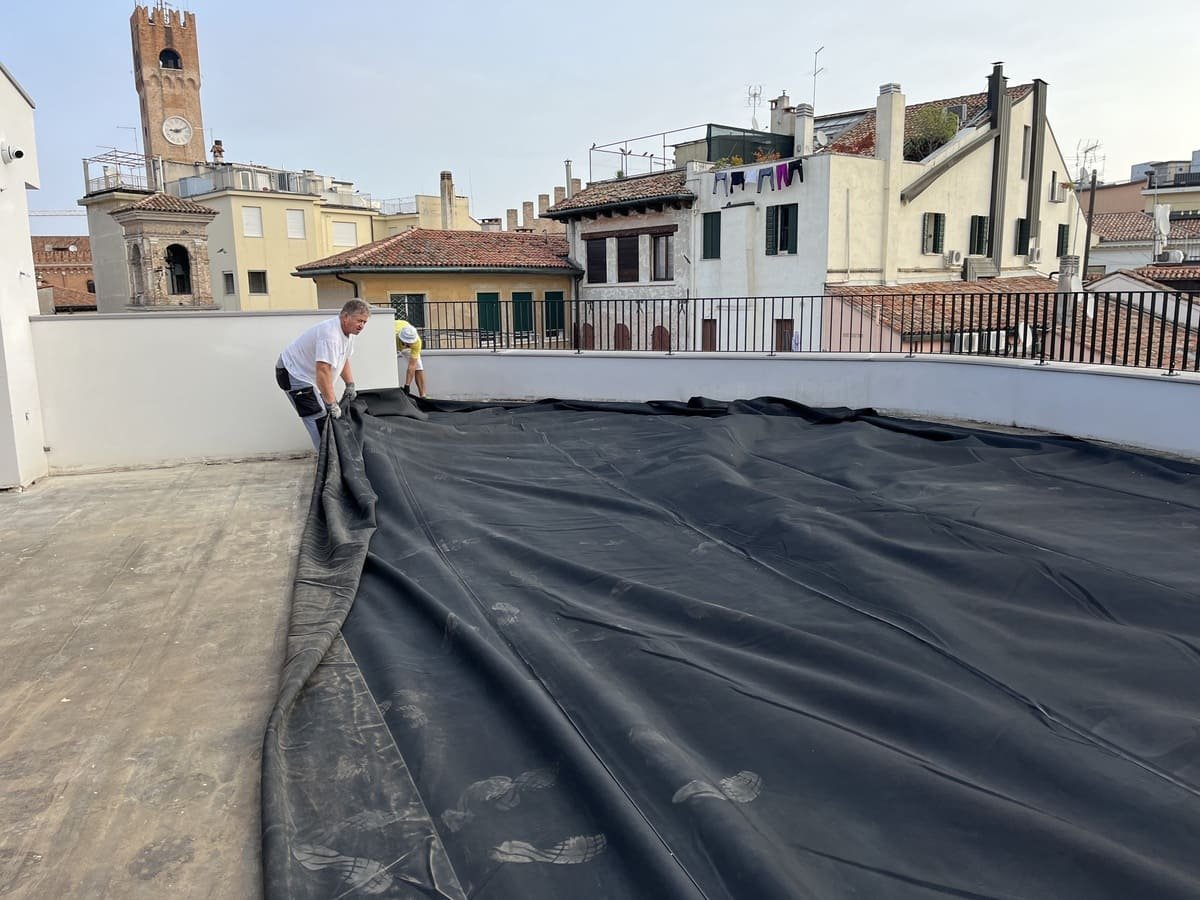
The membranes can be produced in large sizes, up to 450 square meters in a single sheet (15x30 m), according to the dimensions provided during the design phase. This allows for a perfect match between the product and the actual surface of the flat roof, avoiding cuts on site, overlaps, and therefore possible critical points for infiltration. The advantage in terms of reliability is clear: fewer joints mean less risk and greater durability over time.
Back to top
Contact Form
Contact us now or leave your details below for a free professional consultation